What you actually do on Echo
Four moves.
That’s the whole app.
-
See a problem.
 Ping it.
-
Have an idea.
 Wave it.
-
Agree with it.
 Surge it.
-
Want to know what happened?
 Track it.
A Ping is a problem. A Wave is a proposed solution. A Surge is support. Track is where you watch it move.
Being heard is not
the same as being resolved.
The group chat
- People talk
- Messages disappear by morning
- No clear owner
- No status, ever
Echo
- The issue is raised once, clearly
- The community supports it
- Leadership actually sees it
- You can track what happens next
“Everyone’s talking about it” becomes a number leadership can’t ignore.
Getting started on Echo
From sign-up
to your first Ping.
-
Sign up
Create your Echo account and get started.
-
Raise an issue
Raise a Ping about a real campus problem.
-
Build support
Propose a Wave or Surge what matters to you.
-
Track what happens
Follow the issue and see what happens after leadership responds.
What being part of Echo means.
It means
- You can raise real campus problems
- You can propose solutions and support what matters
- You can see what happens after leadership responds
It doesn’t mean
- Paying anything, ever
- Committing your institution to anything
- A guaranteed outcome on any Ping
Your first five minutes on Echo
Start with something that needs fixing.
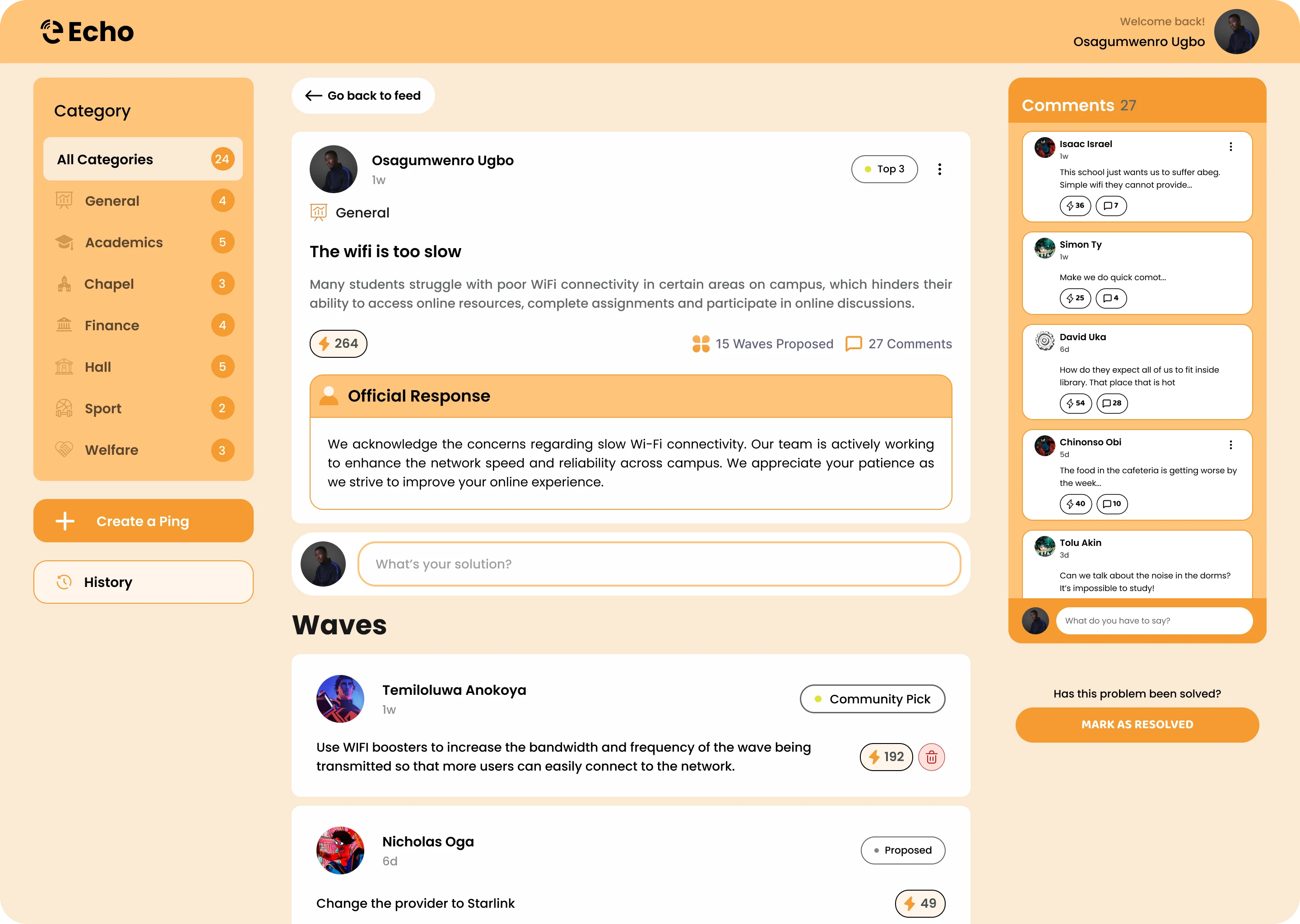

- Ping it.
- Give others a reason to care.
- Watch what happens next.
You can speak
without putting your name on the Ping.
Echo verifies that you belong to your campus community. That’s what keeps out bots and outside noise. But inside the platform, you can raise issues anonymously or pseudonymously. Leadership sees the issue and the support behind it, not automatically you.
Moderation keeps the space accountable, so openness works for everyone who uses it honestly.